
MIKROE-4184

Mikroe
932-MIKROE-4184
MIKROE-4184

Mfr.:

Description:
Interface Development Tools SPI Extend Click

In Stock: 26

Stock:
26 Can Dispatch Immediately
Factory Lead Time:
7 Weeks Estimated factory production time for quantities greater than shown.
Minimum: 1   Multiples: 1
Unit Price:
Rp-
Ext. Price:
Rp-
Est. Tariff:

Pricing (IDR)

Qty. Unit Price
Ext. Price
Rp421.958 Rp421.958

Product Attribute Attribute Value Select Attribute
Mikroe
Product Category: Interface Development Tools
Add-On Boards
SPI
LTC4332
Brand: Mikroe
Country of Assembly: Not Available
Country of Diffusion: Not Available
Country of Origin: RS
Dimensions: 57.15 mm x 25.4 mm
For Use With: Industrial Control, Sensor Installations
Interface Type: GPIO, I2C, SPI
Maximum Operating Temperature: + 70 C
Minimum Operating Temperature: 0 C
Operating Supply Voltage: 3.3 V, 5 V
Product Type: Interface Development Tools
Factory Pack Quantity: 1
Subcategory: Development Tools
Products found:
To show similar products, select at least one checkbox
Select at least one checkbox above to show similar products in this category.
Attributes selected: 0

CAHTS:
8471801000
USHTS:
8471801000
JPHTS:
847180000
TARIC:
8471800000
MXHTS:
8471800402
BRHTS:
84718000
ECCN:
EAR99

Interface Click Boards

Mikroe Interface Click Boards are used to add new interfaces to boards for applications and designs. Mikroe Click Boards are based around the mikroBUS™ interface standard and easily add incredible system capabilities. The devices include interfaces like Ethernet, USB, and Fiber Optics, to name a few.

SPI Extend Click

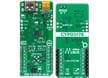
Mikroe SPI Extend Click is used for applications that require extending the SPI communication bus over a long distance. The Mikroe SPI Extend Click board features the Analog Devices LTC4332 SPI Slave Extender device. The LTC4332 can transmit SPI data using a ±60V fault-protected differential transceiver. The LTC4332 includes an interrupt signal, up to 2MHz over two twisted-pair cables. The extended common-mode range and high common-mode rejection on the differential link provide tolerance to large ground differences between nodes. The board can also provide a control interface using a separate slave select for configuration and fault monitoring.